
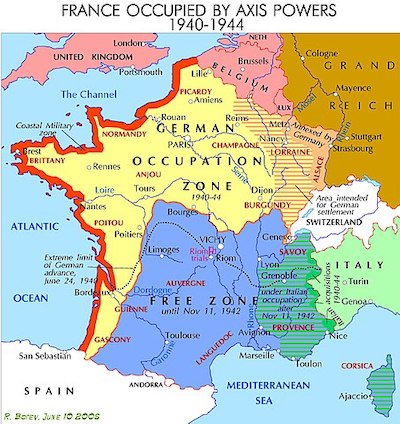
In Madame Rebelle, the true events and landscape of World War II play a significant role in the story. It can be difficult to know what is going on in the real-life backdrop of the war and France’s resistance movements. The different zones France was split into during German occupation can be confusing as well. Below you’ll find a comprehensive timeline of the German occupation of France, the French resistance and maps of the region.
1939
- September 1 – German troops invade Poland. World War II begins.
- September 3 – Britain and France declare war on Germany.

1940
- March – Rationing of food and other goods begins in Paris.
- May 10 – Germany invades Belgium and the Netherlands
- May 10 – German troops bypass the Maginot Line’s fortifications by advancing through the Ardennes, clashing with overwhelmed French forces. The Battle of France begins.
- June 4 – British Expeditionary Force and thousands of French troops are evacuated from Dunkirk. 338,000 Allied soldiers are rescued from its beaches after being trapped by the Germans’ western advance. They are evacuated to Britain.
- June 13 – Paris is occupied by German troops. Organizations were founded by the Germans to loot and transport French art, gold, and wine to Nazi leaders. One of these groups was called the ERR (Einsatzstab Reichsleiter Rosenbeg). Its original objective was to pilfer books and documents but Jewish art collections were also plundered. These valuable items were consistently carted away to Germany throughout the war.
- June – The counterintelligence branch (SD) of the German SS is established at 84 Avenue Foch in Paris. Led by Josef Kieffer, this branch would successfully go on to destroy Churchill’s Special Operations Executive (SOE) networks in France.
- June 16 – Marshal Philippe Petain succeeds Paul Reynaud as French premier.
- June 17 – Petain negotiates with Germany for an armistice.
- June 22 – After the fall of France and the Armistice, France is split into two zones – Zone occupee (Occupied Zone) in the north and western parts of the country, which is occupied by the German Army and Zone libre (Free Zone) in the south headed by the Vichy government and Petain. The Demarcation Line becomes the boundary line between these two territories.
- June 25 – France surrenders to Germany.
- June 28 – General Charles de Gaulle (in exile) is recognized as the leader of the Free French Forces.
- July 11 – Petain becomes dictator of France.
- July 15 – The rationing system is formalized throughout France. Essentials products like milk, butter, meat, oil, sugar, bread, coffee, cheese, eggs, coal, and petrol would continue until the end of the war. Some would be rationed until as late as 1949 after World War II.
- July 22 – British Prime Minister Winston Churchill establishes the Special Operations Executive (SOE) to “set Europe ablaze” with spy networks and sabotage in enemy territory.
- August – Groupe de musee de l’Homme, the first resistance movement in occupied France, is created. One of their clandestine publications, La Resistance, will go on to give the French Resistance its name. (This organization includes Ages Humbert, author of Resistance: One Woman’s Journal of Struggle and Defiance in Occupied France, a rare primary source from a woman in the resistance.)
- Winter 1940 – The Vichy government (conspiring with German occupiers in the Occupied Zone) begins to imprison French Jews in concentration camps throughout France.
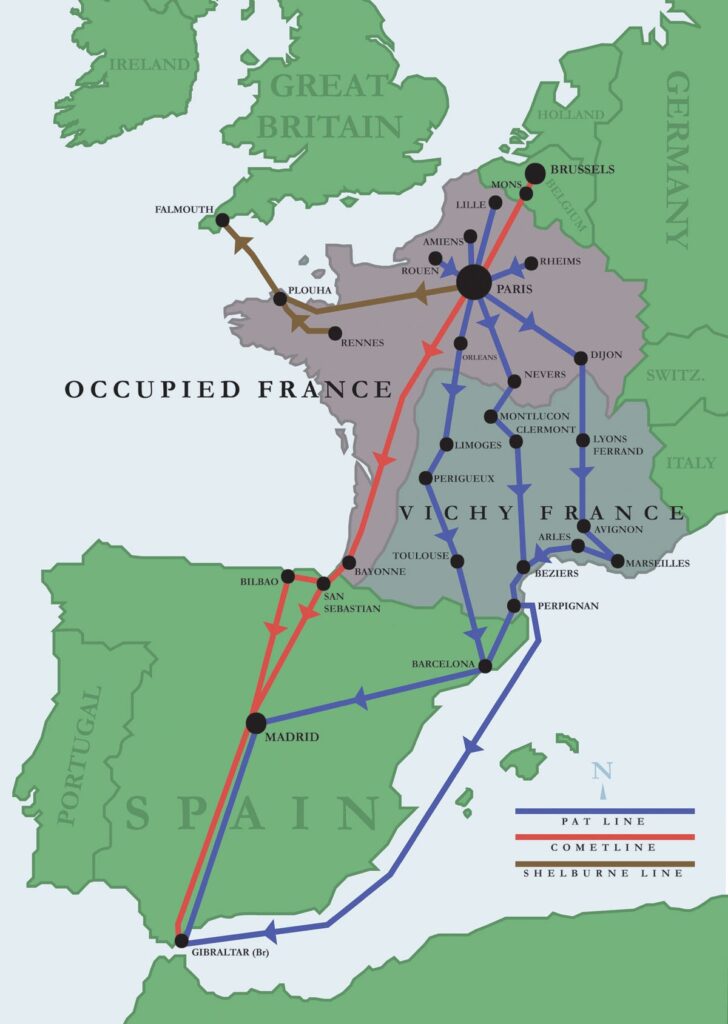
- The Pat O’Leary Line (or the Pat Line/PAO) is created as an escape route for stranded Allied servicemen in France. The route would go on to provide food, clothing, false identification, safehouses and escape for an estimated 7,000 airmen and soldiers.
- The Oeuvre de Secours Aux Enfants, Children’s Aid Society (OSE), begins recruiting Jewish physicians barred by anti-Semitic Vichy law from practicing medicine. The OSE also opens 14 homes for children in Vichy around this time. As a result, nearly 1,200 children were saved from the Holocaust.
1941
- The German Wehrmacht requisition 13,000 trucks from French citizens. They would go on to seize telephones, bicycles, and telegraphs. Pigeons were killed so the French could not use them as carrier pigeons. Passes were soon required for French citizens to travel between towns and on railway lines. In the Occupied Zone, the French were forced to allow German troops to billet in their homes.
- April – Vera Atkins becomes intelligence officer for SOE’s F Section, which operated in France.
- May – In Paris, Jewish men, primarily Polish and Czech, are arrested.
- June 22 – Germany declares war on the Soviet Union, breaking the two Axis countries’ 1939 non-aggression pact and splitting German forces between the Western and Eastern fronts.
- June 13 – The first cache of weapons for the French Resistance is airdropped into France by SOE F Section agents.
- August 21 – A German soldier becomes the first victim of the French Resistance in Paris. In response, the German Army kills 150 Parisians in retaliation.
- August 24 – In Vichy, “anti-terrorist” laws are passed, making resistance activities punishable by death.
- October – Jewish persecution in Paris escalates. Synagogues are bombed. Jewish organizations and businesses are closed or “Aryanized.”
- The Comet Line is created, providing an escape route for Allied servicemen stranded in Belgium and France. It is headed by Andree de Jongh, a member of the Belgian Resistance. She and an estimated 3,000 Belgian and French citizens assisted with the rescue of more than 700 servicemen within three years.
1942
- January 1 – The Declaration by the United Nations is signed by twenty-six nations.
- January 1 – A former French mayor, Jean Moulin, parachutes into France in an effort to organize resistance groups.
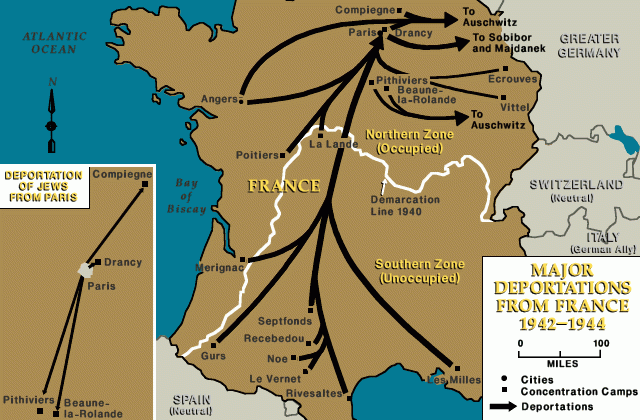
- March – The first French train bound for Auschwitz-Birkenau (Germany’s largest concentration camp) leaves Compiegne, France, carrying mostly French Jews.
- Summer – Foreign and stateless Parisian Jews are deported systematically to transit camps.
- July 16-17 – The Vel d’Hiv Roundup takes place with French police arresting an estimated 13,000 Jews living in Paris. These citizens are imprisoned in the Velodrome d’Hiver in inhumane conditions and eventually deported to Auschwitz-Birkenau.
- October – British SOE agent Frances Suttill (code name Prosper) parachutes into France. He goes on to create and organize the Prosper Network, the most important F Section network due to its size, stretching from the “Ardennes to the Atlantic” in Northern France. At its height, the Prosper Network would employ as many as 30 SOE agents.
- November 6 – Hitler occupies the Free Zone in France, making the German control of France complete and voiding the Demarcation Line between the Occupied Zone and Vichy.
- November 8 – Operation Torch begins when the Allies invade Vichy-controlled Morrocco and Algeria.
- The Dutch-Paris Escape Line is established, providing Dutch Jews with an escape route from persecution and deportation. Between 1942 and 1945, 300 passeurs would smuggle these civilians into France and Switzerland, a neutral country. The line eventually crossed into Spain as well. Approximately 3,000 people (mainly Jews) were rescued by the Dutch-Paris Escape Line.
1943
- January 30 – Vichy forms the Milice francaise (French Militia), a political paramilitary organization made up of German sympathizers, to find, fight and repress members of the French Resistance.
- February – Service du Travail Obligatoire (STO), a compulsory work service program created by German officials for French citizens, forces men of working age to work in Germany to replace German men who were drafted into the armed forces. This move would lead to the founding of the maquis, a resistance movement in rural areas of France.
- May 27 – Jean Moulin (acting on behalf of General Charles de Gaulle) formed the National Council of the Resistance, bringing the Armee Secrete, FTP, and ORA together to fight against German occupiers in France.
- June 3 – The French Resistance destroys 300 tons of tires at Clermont-Ferrant’s Michelin Factory.
- June 21 – Paul Moulin is arrested in a suburb of Lyon, France during a meeting with leaders of the resistance. He is interrogated by Gestapo Chief Klaus Barbie, “The Butcher of Lyon,” who was known for his brutal interrogation methods. During torture and questioning, Moulin remains silent. Soon after, he died after he was put on display as a lesson to other jailed resistance members.
- June – The destruction of SOE’s Propser Network begins when Frances Suttill and others inside the spy organization are captured. They are interrogated at 84 Avenue Foch, headquarters of the German SS counterintelligence branch.
- September 22 – SOE F Section agent Pearl Witherington (code name Pauline) is parachuted into France. She would go on to command a 1,500-strong resistance force.
- December 19 – French Resistance fighters battle German troops in Bernex, France.
- The Shelbourne Escape Line is created by the British military intelligence agency, M19. This escape route provided more stranded Allied servicemen with safehouses and safe passage back to Britain. The Shelbourne Line would go on to save 307 airmen.

1944
- January 19 – The French Resistance blows up an airscrew works factory in southwest France, putting it out of commission for the remainder of the German occupation.
- May 1 – British Squadron Leader and SOE agent Maurice Southgate is arrested in Paris by the Gestapo. Pearl Witherington worked closely with Southgate whose job was to coordinate the maquis groups between the Loire River and the Pyrenees Mountains. He is interrogated at 84 Avenue Foch in Paris by German SS and later deported with 35 other SOE agents to Buchenwald Concentration Camp in Germany.
- May 10 – The French Resistance is now 100,000 strong. It requests additional support from Allied nations.
- June 6 – D-Day begins as 155,000 Allied troops land on the beaches of Normandy, France.
- June 10 – The Oradour-sur-Glane, France massacre takes place during which 642 men, women, and children are killed by German troops in retaliation against resistance activities in the area.
- June 28 – Phillipe Henriot, a Milice leader and Minister of Information is killed by resistance fighters. As a result, Milice leader Paul Touvier rounds up several Jewish prisoners to be shot in reprisal in Lyon, France.
- July 19 – In France and Belgium, propaganda leaflets are airdropped by several US B-17 bombers. Supplies for the French Resistance are dropped by B-24 bombers as well.
- July 20 – Again, several B-17 bombers are dispatched to drop leaflets over France. More supplies for resistance fighters are dropped by B-24s.
- August 15 – The Allies invade southern France.
- August 16 – The French Resistance captures three German strongholds along the Swiss border.
- August 19 – Secret French Resistance fighters attack the German Army in Paris.
- August 20 – Resistance fighters free the city of Toulouse in southern France.
- August 25 – Paris is liberated by the Allies.
- October 23 – General de Gaulle is recognized as head of the provisional French government.
- November 16 – The Battle of the Bulge begins with German counterattack in the Ardennes.
- The Soviet Union pushes German troops out of Russia, Ukraine, and Belarus, placing them on the advance and the Germans into retreat on the Eastern Front.
- Philippe Petain and other Vichy cabinet officials flee to Germany in response to the Allied invasion of France. There, they establish a government-in-exile.
1945
- January 25 – The Battle of the Bulge comes to an end after five weeks.
- January 27 – Auschwitz-Birkenau is liberated by the Soviet Army in Poland.
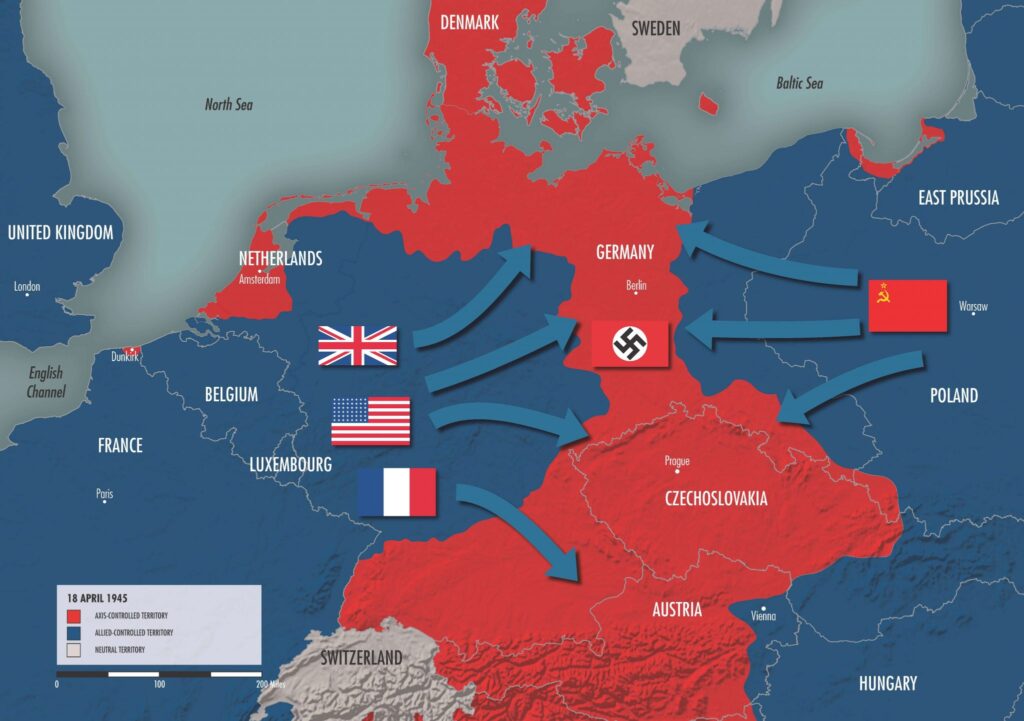
- March 22-23 – Allied forces cross the Rhine River in Germany.
- March 23 – Around this date, Frances Suttill, leader of SOE F Section’s Prosper network, is executed at Sachsenhausen concentration camp near Berlin after being held in solitary confinement under the Nacht und Nebel, the Germans’ “Night and Fog” decree. (Nacht und Nebel sought to make political activists and resistance fighters “disappear.”) Sachsenhausen is liberated a mere month after Suttill’s death.
- April – Petain returns to France.
- April 11 – American troops liberate Buchenwald Concentration Camp, freeing SOE agent Maurice Southgate who had miraculously escaped execution.
- April 21 – Soviet Army enters Berlin.
- May – In France, the first legislative elections are held since 1940. For the first time, women are allowed to vote.
- May 1 – Hitler is reported dead. Karl Donitz claims to be his successor.
- May 2 – Berlin surrenders to the Allies.
- May 8 – Victory in Europe Day, aka VE Day, is declared with celebrations throughout Europe.
- June – In France, the Epuration Legale, or “legal purge” begins in response to the country’s eagerness to see Vichy leaders, officials and collaborators punished. Among these is Minister of the Interior Pierre Pucheu who was found guilty of treason and sentenced to death. Leader of the Milice, Joseph Darnand, received the same verdict.
- July 31 – Former prime minister of Vichy, Pierre Laval, surrenders to the Allies in Austria. He is later executed for treason.
- August 14 – Petain is sentenced to death for treason and collaboration with the Germans. Later, de Gaulle commutes his sentence due to Petain’s advanced age and his service to France in World War I. Instead, he went on to serve a life sentence on an island off the coast of France. He died in 1951.
- September 2 – World War II ends after Japan surrenders to the United States following the bombings of Hiroshima and Nagasaki. It is estimated that 20-25 military personnel were killed during the war. The majority of deaths, however, were civilian (40-60 million).
- October – A new political system in France is welcomed by a vast majority of voters.
- November 5 – The French elect Charles de Gaulle head of the provisional government.
- November 20 – The Nuremberg trials take place during which German leaders and officials are held accountable for war crimes and crimes against humanity. The trials would give rise to the principles and procedures of the Genocide Convention, the Universal Declaration of Human Rights, and the Geneva Conventions.
- Surviving French civilians deported or imprisoned by Germany are repatriated.
- Britain’s SOE is disbanded.
1946
- SOE intelligence officer Vera Atkins travels to France in search of 118 missing SOE agents from F Section. Her search leads her to Germany where she interrogates suspects of Nazi war crimes, including a commander of Auschwitz-Birkenau and Major Josef Kieffer of the German SS. She also provides evidence against Nazi war criminals, particularly in the Ravensbruck concentration camp trail where many female SOE agents were killed.
- Klaus Barbie, the “Butcher of Lyon,” cooperated with US Army Counterintelligence Corps (CIC). The organization aided in his escape through the “Rat Line” for defectors and informants. In Bolivia, he worked for West German intelligence. The Bolivian government protected him and his family. He was not extradited back to France until 1983 where he was at last tried and convicted.
- French authorities arrest pilot Henri Dericourt (code name Gilbert) of SOE’s F Section. Many speculated that he turned double agent and aided in the break down of SOE’s Prosper Network. During his trial later in 1948, he would be acquitted due to lack of the hard evidence against him.
- December 24 – The French Fourth Republic is founded.
Sources
- Cobb, Matthew. The Resistance: The French Fight Against the Nazis. Simon & Schuster, 2009.
- Cornioley, Pearl Witherington, and Kathryn J. Atwood. Code Name Pauline: Memoirs of a World War II Special Agent. Chicago Review Press, 2013.
- Helm, Sarah. A Life in Secrets: Vera Atkins and the Missing Agents of WWII. Anchor, 2008.
- Humbert, Agnes. Resistance: A French Woman’s Journal of Struggle and Defiance in Occupied France. Originally published in 1946. Republished by Bloomsbury Publishing, 2008.
- Moorehead, Caroline. A Train in Winter: An Extraordinary Story of Women, Friendship and Survival in World War Two. Harper Perennial, 2012.
“Don’t just survive…resist.”
Champagne, France 1943
Meet Madame Rebelle. Edmee Guillon is a smuggler. She hides people from the German troops surrounding her ancestral home. When a dying man in a German uniform seeks refuge at Maison Boutet, Edmee struggles to believe his claims that he is French. Her life, the maison and the people she loves are already at stake. Can she take the chance that this mysterious spy is who he says he is? And which side of this war is he really on?
Christian Vovk has been betrayed by someone inside his resistance organization. He knows asking the striking young war widow to hide him will put her in certain danger. However, Christian can help Edmee save as many refugees as she can. Falling in love with her will hinder his duty to the operation that brought him to her doorstep in the first place. When love and duty become inevitably tangled, will Christian sacrifice one for the other?